


It appears that the world’s top corporate AI leaders — from Open AI and Google to Meta and Microsoft — subscribe firmly to the view that the trillion-dollar global AI race to build an uncontrollable superintelligence is inevitable and something they have no choice but to participate in. They commonly link this presumed inevitability and their unwillingness to slow things down to China (‘if we don’t press ahead they surely will; would you rather live in a world run by American or Chinese AI?’). Privately, they hope that it will be their specific company that will birth a new non-human intelligence that will ‘run the world’, with the latter perhaps agreeing to some degree of power sharing with its parents.
But is this mad dynamic truly as inevitable as we are being told? Or can we somehow discover a way out of this dilemma — that clearly does drive behaviour — of leaders choosing to invest massively to ‘win’ an unregulated race towards an AI that may end civilisation or at least damage it irredeemably in myriad ways?
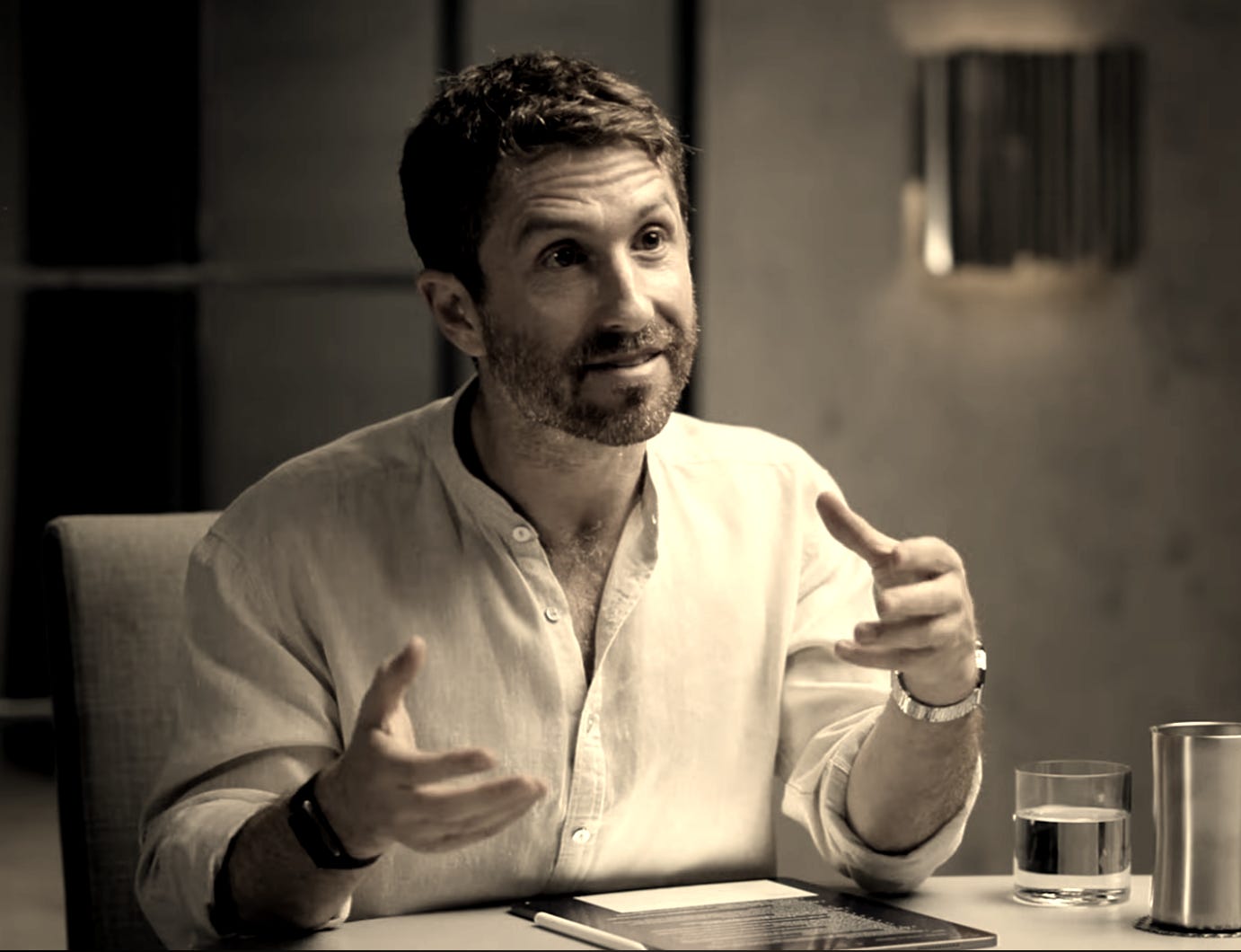
In an important recent appearance on the Diary of a CEO podcast on 27 Nov 2025, the AI ethicist Tristan Harris (Center for Humane Technology) did something I thought was quite remarkable — he brought a sense of holistic intelligence to bear upon this problem. Taking a step back, Harris was able to cut through to a pivotal contradiction at the heart of the irrational race to a superintelligent AI, effectively dissolving the inevitability argument.
Here’s a key excerpt (starting at 32:56):
“If everybody who’s building it believes [that racing to create a superintelligence that will wipe out humanity] is inevitable and the investors funding it believe it’s inevitable, it co-creates the inevitability…And the only way out is to step outside the logic of inevitability.”
“And I think the goal for me [of] this conversation is to get people to see that that’s a bad outcome that no-one wants. And we have to put our hand on the steering wheel and turn towards a different future because we do not have to have a race to uncontrollable, inscrutable, powerful AIs…”
What impresses me about this perspective shift performed by Tristan is how it (1) reveals the prevailing pattern of assumptions for what they are — mere flawed assumptions that conceal a deep contradiction while (2) freeing us to discover an entirely different direction that remained hidden by those original assumptions (and this does need not conform to Harris’s own preferences).
One key flaw of the ‘inevitabilists’ is this: if the hyperintelligent AI that they are competing to build is indeed likely to transcend human control, does it make any sense to worry about whether it will be ‘Chinese’, ‘American’ or even ‘Russian’? Surely an ‘uncontrollable’ AI won’t align itself with our conventional national interests or borders. If so, using any kind of nationalistic or power-driven arguments to justify investing billions to ‘be the first’ to enact such AI seems no different to as proudly inventing a virus that then kills all or most humans in every country.
For me, the key hallmarks of what one might call holistic intelligence (or in Bohmian terms, intelligent perception) include freeing oneself from all types of conditioning and distortion, including external assumptions as well as ego-driven beliefs and behaviours, and then aiming to bring one’s fullest capacities for perception to bear upon a situation. Although such intelligence lies beyond the realm of standardisation and reductionism (meaning it can’t be turned into a ‘method’), applying it enables one to access underlying truths about a given situation, be that situation personal, socio-technical or political in nature. The ‘holistic’ or ‘total’ character of such intelligence means it is concerned with wholes formed of complex inter-relationships that can be most clearly seen when assumptions and preoccupations with the self don’t cloud our vision. Individuals capable of such clarity and honesty remain incredibly rare in contemporary society, which is why we should seek to learn actively from those who demonstrate aspects of this capability.
While many academic AI ethicists might remain critical of Harris’s focus on ‘doomsday’ scenarios and attempts to raise alarm in a way that may background other vital issues (such as global heating and present-day inequalities shaped by invisible and inscrutable algorithms), I appreciate his attempts to apply a sense of holistic intelligence to a global dilemma that is genuinely shaping the future of the planet. It is not just that he has managed to dissolve the argument positioning the race to uncontrollable AI as inevitable — he is also reminding us that we must continuously bring our best holistic intelligence to wisely governing all aspects of evolving technologies and social-ecological-technical systems. Although nothing is inevitable, perhaps it will be a more conscious fusion of our very human holistic intelligence with narrow and safe uses of AI that will prove to be the winning combination for humanity.